


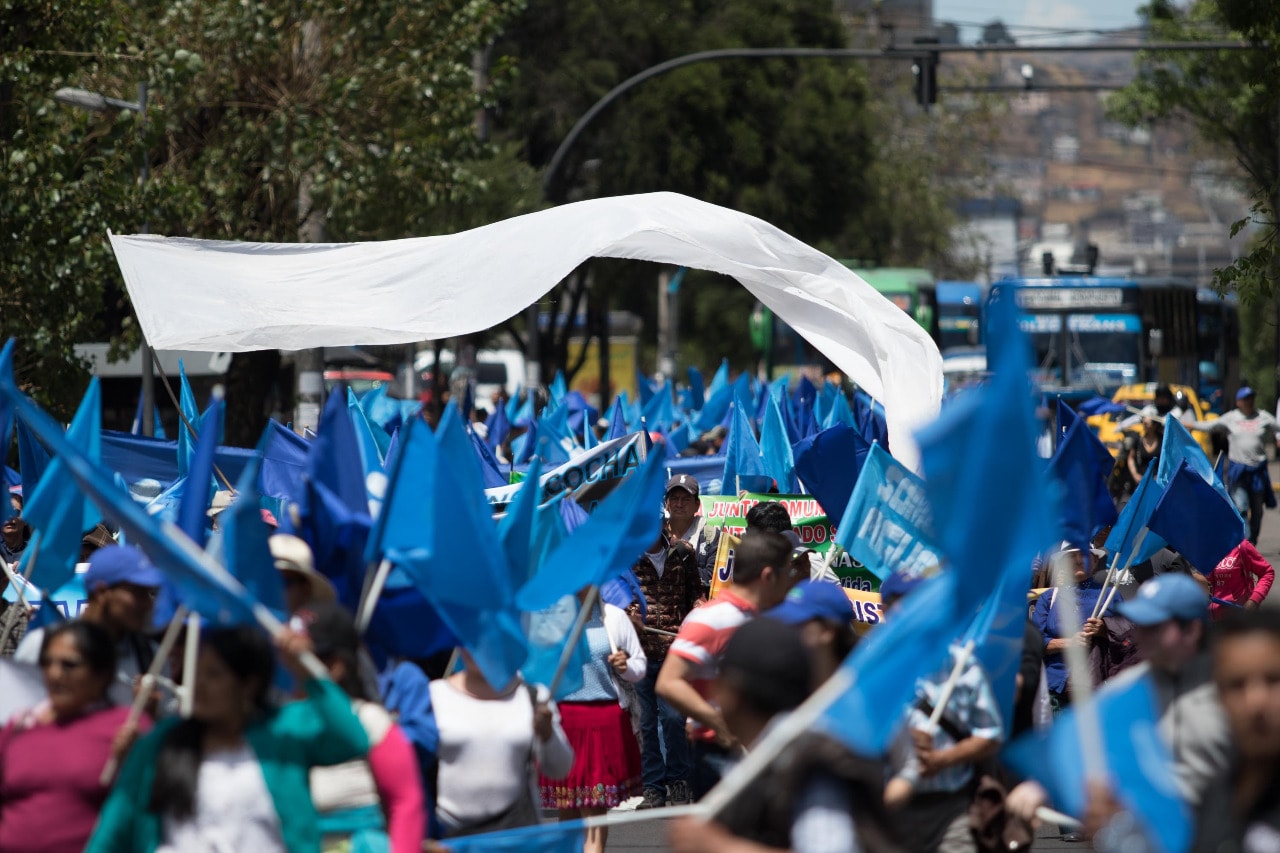
Mining in Azuay: a David vs. Goliath story
Azuay, a province in the south of Ecuador with Cuenca as its historic and cultural provincial capital, has rapidly developed into an emblematic region in the fight against mining.
In the canton of Girón, in the province of Azuay, a public consultation (Consulta Popular) was organized on the 24th of March 2019 about the large-scale mining project Loma Larga. An historic event, because it was the first local referendum in Ecuador on a mining activity.
During the Consulta Popular in Girón, the inhabitants were asked whether they agreed with extracting gold in the Páramo of Kimsacocha, located in the Cajas National Park. A páramo is a fragile ecosystem in the Andes High Mountains that is vital for water supply in the region and in the country.
The result of the referendum was convincing! 87% of the community preferred water to gold and said “si a la vida, no a la minería”. An important precedent in Ecuador, because after this victory, other provinces tried to follow suit. Imbabura and Carchi, two provinces in the north of Ecuador, recently submitted an application for a Consulta Popular, but unfortunately this has been rejected by the Ecuadorian Constitutional Court.
Also in terms of political leadership, the importance of the province of Azuay should not be underestimated. In May 2019 the inhabitants elected Yaku Pérez Guartambel as the new prefect. Since then, he has led the autonomous government of the province of Azuay.
Yaku Pérez is known for his strong statements against the mining sector and his ambition to legally clear the province of Azuay from metal mining, in particular by organizing referendum. Yaku Pérez quickly became a symbolic figure in the country.

A constitutional problem
Following the victory of the referendum in the canton of Girón, Yaku Pérez called for a general referendum on mining activities in the province of Azuay. This question was submitted to the Constitutional Court, but after a hearing on the 17th of September 2019, this request has been rejected.
Pérez clearly expressed his dissatisfaction with the nature of the hearing. According to him, the President of the Court must hold a public hearing before taking a decision, as is customary in constitutional matters. “We want a public hearing so that we can look the judges in the eye and speak from the heart. To demonstrate in a factual and legal way the need for a public consultation,” according to Pérez.

Moreover, there is a conflict of interests within the Court. One of the constitutional judges, Dr. Ramiro Avila Santamaria, was not allowed to take part in the hearing because of earlier statements against extractivism. Other judges, who clearly have ties with the mining sector, were allowed to participate. Judge Carmen Corral is a lawyer at Solines Asociados, a law firm that provides advice and support to mining companies. Another judge, Hilda Nugues, is a member of the mediation committee of the Guayaquil Chamber of Commerce, which has spoken out against the referendum.
There is clearly a lot of pressure from the national government and the large multinationals. There is great concern about what happened in Girón and fear about the outcome of such referendum at provincial and national level.

Campaign against Yaku Pérez
It was no coincidence that on the same day as the hearing, the pro-mining sector distributed a campaign on Twitter in which they attacked Yaku Pérez.
They claimed that Pérez would have had mining concessions in the period 1999-2000 because his name was found in the mining register.
Yaku Pérez disclaimed this argument. At the time, as a lawyer, he would have signed documents for the extraction of sand and stones for construction works in the province. This type of mining also is registered, but it doesn’t concern metal mining.
The battle continues
Following the negative decision of the Constitutional Court, Pérez announced that he would step up the resistance and open a wider door by organizing a referendum at national level.
The Ecuadorian Constitution recognizes the Consulta Popular as a legal citizens’ initiative. However, the mining industry and the Ecuadorian government argue that local consultations on mining cannot take place because the natural resources in the subsoil are a matter of national concern.

Moreover, the constitution states that the powers of various policy bodies are not exclusive, but competitive. “You may be the owner of what is in the subsoil, but you have to pass over the soil,” says lawyer Verónica Potes, expert in environmental law and human rights.
“It’s a battle of David vs. Goliath”, says Yaku Pérez, “There aren’t many of us, but we have the truth, the reason and the legitimacy to our advantage. We continue the resistance and if necessary, we will denounce this issue before the international courts.”